Tell us about the job
Takes about a minute. No obligation.
A heat pump limping through summer or refusing to heat in January is probably not a storm casualty. 107 severe weather events were recorded in Harnett County, North Carolina between 2015 and 2024. That puts Harnett County in the middle of the national picture, not among the counties where severe weather is a standing operating condition for every system. A contractor diagnosing a repair here will check refrigerant levels, contactor wear, and coil condition first, because those are what degrade on a system that has simply aged or gone without service, and that is what the evidence points to most often in this county.
Ducting and electrical in a house this age have already lived through at least one prior system. The heat pump running in it now is not the first piece of equipment that house has seen, which means a contractor opening it for repair is looking at components that reflect those successive choices, not a single original install. Half the homes in Harnett County, North Carolina were built in 1997 or earlier (2020-2024 ACS 5-year). That history shapes what the opened unit turns out to hold: a compressor or reversing valve from a product line that has since been discontinued, or a refrigerant spec that parts suppliers no longer stock as a matter of course. What a contractor quotes for the repair depends on what is actually inside, not on what the model label says should be.
The Parts of a Heat Pump a Contractor Checks First
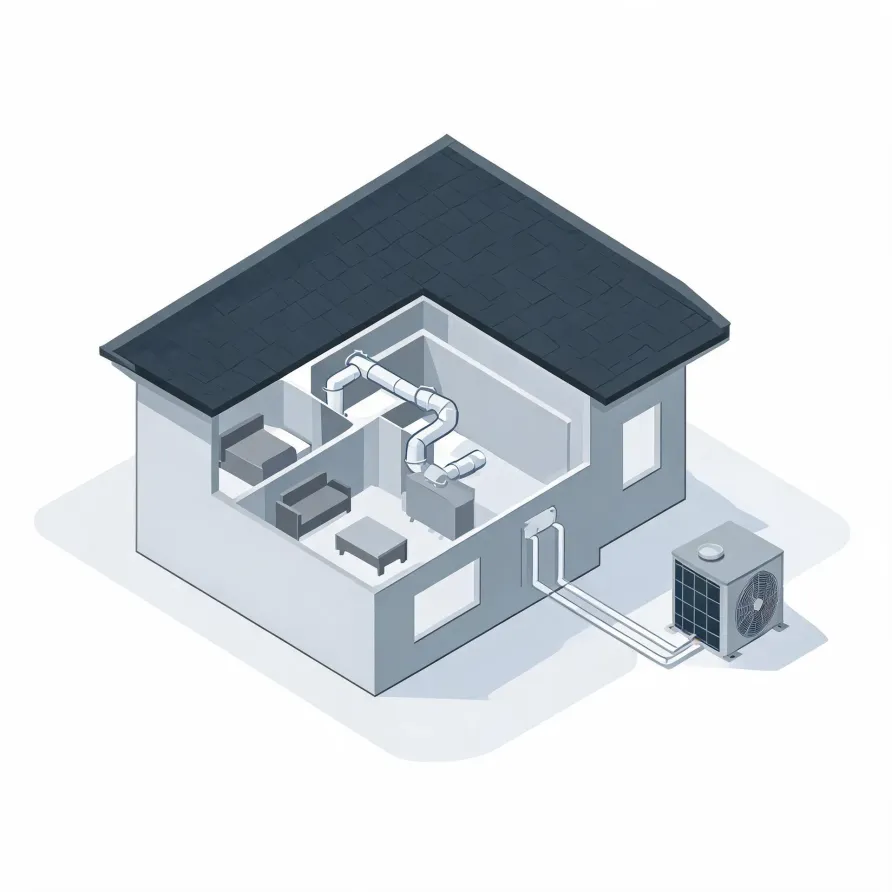
The outdoor unit sits outside the house and holds the compressor and condenser coil. These are the parts a contractor goes to first when a heat pump stops heating or cooling properly. A failed compressor, a refrigerant leak at the coil, or a seized fan motor in that cabinet will each kill the system in a different way.
The air handler lives inside, usually in a closet, attic, or mechanical room, and moves conditioned air across the evaporator coil into the home. The expansion valve, the refrigerant lines connecting the two units, and the reversing valve that lets the system shift between heating and cooling modes are all points a contractor checks when the symptom points past the obvious.
The drawing shows a typical layout, and a licensed contractor determines which parts and conditions apply to your specific house.
Find a contractor in Harnett CountyHarnett County, by the numbers
107 severe weather events were recorded in Harnett County, North Carolina between 2015 and 2024.
NOAA National Centers for Environmental Information, Storm Events Database, bulk CSV export, events 2015-01-01 through 2024-12-31.Half the homes in Harnett County, North Carolina were built in 1997 or earlier (2020-2024 ACS 5-year).
U.S. Census Bureau, 2020-2024 American Community Survey 5-Year EstimatesHarnett County, North Carolina holds 54,902 housing units (2020-2024 ACS 5-year).
U.S. Census Bureau, 2020-2024 American Community Survey 5-Year EstimatesOwners occupy 71.0% of the occupied homes in Harnett County, North Carolina (2020-2024 ACS 5-year).
U.S. Census Bureau, 2020-2024 American Community Survey 5-Year EstimatesRules & Standards Governing Heat Pump Repair in Harnett County, North Carolina2 sourced rules and standards
What Harnett County and North Carolina Require for HVAC Repair
North Carolina issues Class I heating licenses covering all systems in all structures, and Class II licenses covering heating systems in single-family detached residential dwellings.
North Carolina requires a license before any person or firm may engage in, or offer to engage in, the business of heating contracting.
Severe Weather Events in Harnett County
Extreme weather puts heat pumps under sustained stress, and stress is what brings repairs forward. How hard the weather hits Harnett County shapes how hard the equipment works.
107 severe weather events, 2015–2024. Source: NOAA National Centers for Environmental Information, Storm Events Database.