Tell us about the job
Takes about a minute. No obligation.
A contractor arriving to repair a heat pump in Franklin County is working out what the equipment has already been through, not just what stopped working today. 115 severe weather events were recorded in Franklin County, North Carolina between 2015 and 2024. At that rate, severe weather is a standing condition of operating here, and the compressor, capacitors, and refrigerant lines carry that load season after season. When something fails, a thorough contractor checks those components for cumulative stress wear before pricing a straightforward swap.
Repair work on a heat pump turns on what a contractor actually finds once the unit is open: the condition of the refrigerant circuit, the state of the electrical connections, and whether the parts that system takes are still available. Half the homes in Franklin County, North Carolina were built in 1997 or earlier (2020-2024 ACS 5-year). That history matters here because a house built well before the heat pump era was wired and fitted for something else first. What serves the heat pump now was adapted, not designed for it, and the intervening years between the original installation and the current equipment are where corrosion, overloaded contacts, and sourced-to-order parts quietly accumulate.
The Parts of a Heat Pump a Contractor Checks First
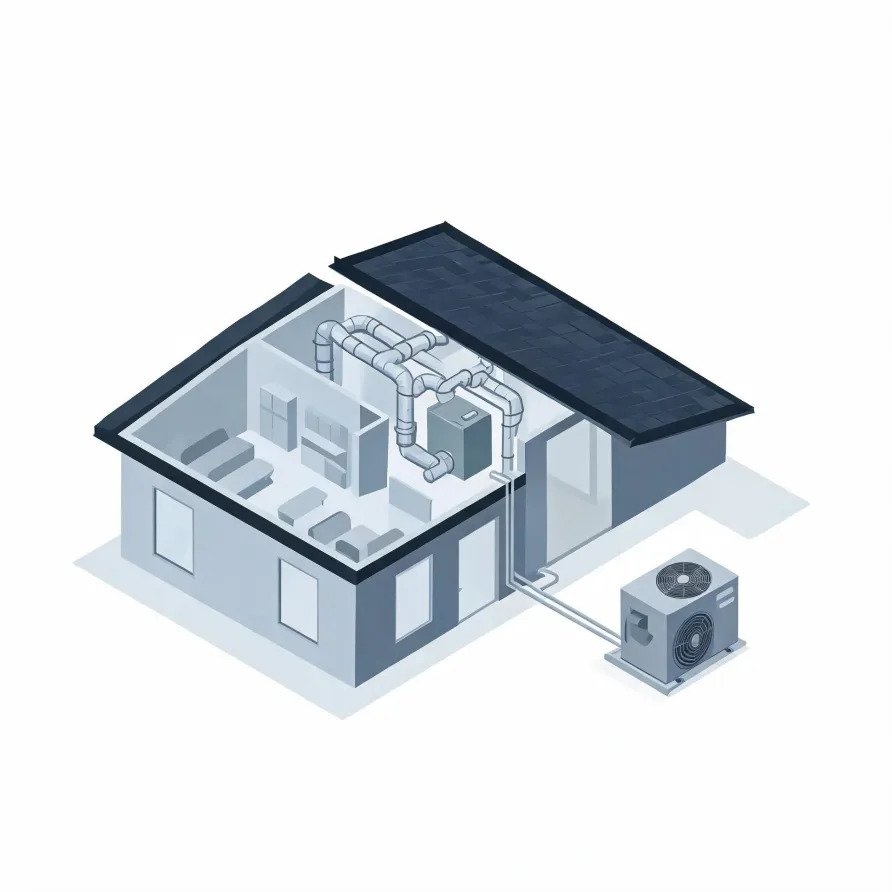
The outdoor unit sits on a pad beside the house and holds the compressor and condenser coil, which are where most failures show up. The compressor is the heart of the system; when it labors or quits, the whole system loses its ability to move heat. The condenser coil and the fan motor that pulls air across it are checked early because damage or blockage there is visible and direct.
Inside the house, the air handler contains the evaporator coil, the blower motor, and the expansion valve. The evaporator coil can ice over or develop a refrigerant leak, the blower motor can fail or run weak, and the expansion valve controls refrigerant flow precisely enough that a small fault throws off the whole cycle. The refrigerant lines connecting the two units and the reversing valve, which lets a heat pump shift between heating and cooling, are also on a contractor's checklist.
The drawing shows the general layout of a heat pump system, and a licensed contractor determines what applies to the specific equipment and installation in your house.
Find a contractor in Franklin CountyFranklin County, by the numbers
115 severe weather events were recorded in Franklin County, North Carolina between 2015 and 2024.
NOAA National Centers for Environmental Information, Storm Events Database, bulk CSV export, events 2015-01-01 through 2024-12-31.Half the homes in Franklin County, North Carolina were built in 1997 or earlier (2020-2024 ACS 5-year).
U.S. Census Bureau, 2020-2024 American Community Survey 5-Year EstimatesFranklin County, North Carolina holds 31,767 housing units (2020-2024 ACS 5-year).
U.S. Census Bureau, 2020-2024 American Community Survey 5-Year EstimatesOwners occupy 78.6% of the occupied homes in Franklin County, North Carolina (2020-2024 ACS 5-year).
U.S. Census Bureau, 2020-2024 American Community Survey 5-Year EstimatesCodes & Standards Behind Heat Pump Repair in Franklin County, North Carolina2 sourced rules & standards
Licensing and Legal Requirements in Franklin County, North Carolina
North Carolina issues Class I heating licenses covering all systems in all structures, and Class II licenses covering heating systems in single-family detached residential dwellings.
North Carolina requires a license before any person or firm may engage in, or offer to engage in, the business of heating contracting.
Severe Weather Events in Franklin County
Weather puts load on heat pumps. Every extreme swing in temperature or a storm that cuts power and then restores it makes the equipment work harder, and that wear shows up as repair calls.
115 severe weather events, 2015–2024. Source: NOAA National Centers for Environmental Information, Storm Events Database.