Tell us about the job
Takes about a minute. No obligation.
A heat pump that breaks down in Washington County has almost certainly spent more time fighting ordinary wear than severe weather. 50 severe weather events were recorded in Washington County, North Carolina between 2015 and 2024. At that rate, the weather is a real but limited factor in what a contractor finds when they open a unit. Refrigerant loss, failing capacitors, and compressor wear driven by deferred service show up far more often than damage tied to storm events. A contractor quoting a repair here starts with service history and component age, because those are what the evidence points to.
The ductwork and electrical connections in a house here carry the history of every system that ran through them before this one. Half the homes in Washington County, North Carolina were built in 1975 or earlier (2020-2024 ACS 5-year). That kind of age in a housing stock means a contractor opening a heat pump for a repair is also opening a question about what the system around it was built to handle. Flex duct added in stages, wiring spliced at the disconnect, refrigerant lines rerouted through spaces that were never meant for them: these are what a repair call turns up once the unit comes apart. The repair on the equipment itself is often straightforward. What takes longer is tracing a fault back through connections that have been touched more than once by hands working around the original build.
The Parts of a Heat Pump a Contractor Checks First
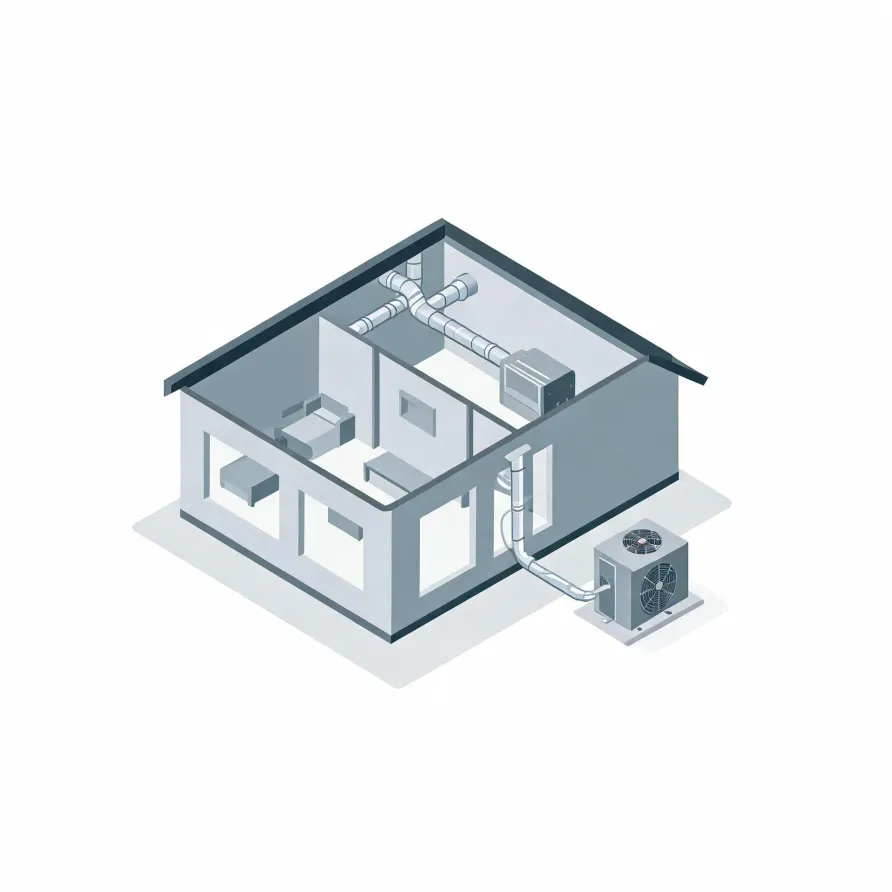
The outdoor unit is where most repairs begin. It holds the compressor, which is the heart of the system, along with the condenser coil and a fan. When the system is not moving heat properly, a contractor looks at this unit first, checking whether the compressor is running, whether the coil is intact, and whether the fan is turning freely.
Inside the house, the air handler contains the evaporator coil and the blower that pushes conditioned air through the home. The reversing valve, which sits in the refrigerant line and tells the system whether to heat or cool, is another piece a contractor checks when the system runs but delivers the wrong temperature. The refrigerant lines themselves connect the two units and can develop leaks at fittings or along the copper tubing.
The drawing shows a typical layout, and a licensed contractor will determine which components apply to the specific system and conditions in your home.
Find a contractor in Washington CountyWashington County, NC, by the numbers
50 severe weather events were recorded in Washington County, North Carolina between 2015 and 2024.
NOAA National Centers for Environmental Information, Storm Events Database, bulk CSV export, events 2015-01-01 through 2024-12-31.Half the homes in Washington County, North Carolina were built in 1975 or earlier (2020-2024 ACS 5-year).
U.S. Census Bureau, 2020-2024 American Community Survey 5-Year EstimatesWashington County, North Carolina holds 6,040 housing units (2020-2024 ACS 5-year).
U.S. Census Bureau, 2020-2024 American Community Survey 5-Year EstimatesOwners occupy 68.0% of the occupied homes in Washington County, North Carolina (2020-2024 ACS 5-year).
U.S. Census Bureau, 2020-2024 American Community Survey 5-Year EstimatesCodes & Standards Covering Heat Pump Repair in Washington County, North Carolina2 sourced rules and standards
Licensing Rules for HVAC Repair in Washington County, North Carolina
North Carolina issues Class I heating licenses covering all systems in all structures, and Class II licenses covering heating systems in single-family detached residential dwellings.
North Carolina requires a license before any person or firm may engage in, or offer to engage in, the business of heating contracting.
Severe Weather Events in Washington County by Year
Storms and temperature swings put real hours on heating and cooling equipment, and those hours accumulate differently depending on where a system runs. Heat pump repair needs in Washington County are shaped by what the local climate actually demands from the equipment.
50 severe weather events, 2015–2024. Source: NOAA National Centers for Environmental Information, Storm Events Database.