Tell us about the job
Takes about a minute. No obligation.
A heat pump failure in Martin County almost always traces back to age or how the system was put in, not to the weather it has run against. 72 severe weather events were recorded in Martin County, North Carolina between 2015 and 2024. At that rate, severe weather is an occasional fact of life here rather than a grinding constant, and a contractor working through a repair does not need to treat storm load as the default explanation for a worn capacitor, a sluggish compressor, or a refrigerant problem. What they look at first is how old the system is and whether the original install was done to spec.
Half the homes in Martin County, North Carolina were built in 1975 or earlier (2020-2024 ACS 5-year). A heat pump sitting in a house built that long ago has likely had parts swapped, connections retaped, and refrigerant topped off by more than one technician over the years, and what that history leaves behind is not always visible from the outside. When a unit finally stops keeping up, the opened system is where the real picture forms: corroded contacts, a capacitor that has been running soft, or refrigerant lines that have lost integrity at a joint. A contractor working on stock this age prices and scopes the job from what the opened equipment shows, not from the service call description.
The Parts of a Heat Pump a Contractor Checks First
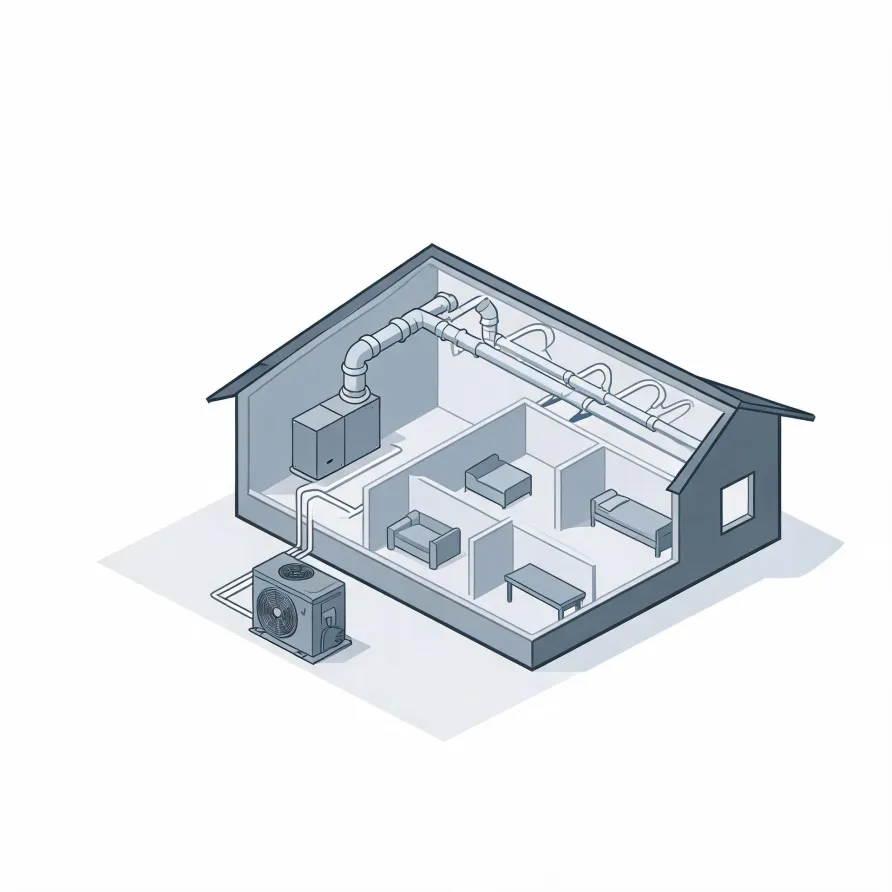
The outdoor unit is usually where a contractor starts. It houses the compressor, which does the core work of moving refrigerant through the system, and the outdoor coil, which transfers heat with the air around it. A failed compressor or a damaged coil will stop the system from conditioning air at all.
Inside the house, the air handler holds the indoor coil and the blower fan, which pulls air across the coil and pushes it through the vents. The refrigerant lines connecting the two units and the reversing valve, which is what lets a heat pump both heat and cool, are also points a contractor examines when the system is not behaving as it should.
The drawing shows a general layout of these components, and a licensed contractor determines what applies to your specific system.
Find a contractor in Martin CountyMartin County, NC, by the numbers
72 severe weather events were recorded in Martin County, North Carolina between 2015 and 2024.
NOAA National Centers for Environmental Information, Storm Events Database, bulk CSV export, events 2015-01-01 through 2024-12-31.Half the homes in Martin County, North Carolina were built in 1975 or earlier (2020-2024 ACS 5-year).
U.S. Census Bureau, 2020-2024 American Community Survey 5-Year EstimatesMartin County, North Carolina holds 11,058 housing units (2020-2024 ACS 5-year).
U.S. Census Bureau, 2020-2024 American Community Survey 5-Year EstimatesOwners occupy 66.8% of the occupied homes in Martin County, North Carolina (2020-2024 ACS 5-year).
U.S. Census Bureau, 2020-2024 American Community Survey 5-Year EstimatesCodes & Standards Governing Heat Pump Repair in Martin County, North Carolina2 sourced rules and standards
Licensing Rules for HVAC Repair in Martin County, North Carolina
North Carolina issues Class I heating licenses covering all systems in all structures, and Class II licenses covering heating systems in single-family detached residential dwellings.
North Carolina requires a license before any person or firm may engage in, or offer to engage in, the business of heating contracting.
Severe Weather Events in Martin County by Year
Weather puts a measurable load on heat pump equipment, and that load varies by location. How hard the climate works a system in Martin County shapes how often that system needs repair.
72 severe weather events, 2015–2024. Source: NOAA National Centers for Environmental Information, Storm Events Database.